04.02.13, 21:00, dodany przez Galadhorn
Source: Lambengolmor, Facebook
Next Vinyar Tengwar (#50) is being prepared by its editors. This is Carl F. Hostetter’s announcement posted to the Lambengolmor mailing list:
 Thanks to a long year-end break and the easing up of professional obligations, I am pleased to announce that the long-awaited 50th issue of „Vinyar Tengwar” is nearing completion. VT 50 contains my presentation and analysis of the “Túrin Wrapper”, featuring a set of three untranslated Sindarin texts from the (probably early) 1950s pertaining to the “Túrinssaga”.
I hope to have the issue completed, printed, and mailed off by March 1.
Please note that henceforth issues of „Vinyar Tengwar” will be available only through the online, print-on-demand publisher Lulu.com, which currently also publishes the various volumes of “The Collected Vinyar Tengwar” [link]. Once VT 50 has been mailed, I will be adding it to, and thus completing, volume 5 of “The Collected Vinyar Tengwar”.
Current subscribers to VT please note: if you have moved in the years since VT 49 was published, please email me […] as soon as possible with you current mailing address. And thank you very much for your long patience!
Also the Parma Eldalamberon (‚The Book of Elven Tongues’ No. 21 edited by Christopher Gilson) is going to be published by late Spring. This one will focus on Qenya nouns.
The magazines have their website at E.L.F.
Vinyar Tengwar (ISSN 1054-7606) is a not-for-profit refereed journal of the Elvish Linguistic Fellowship, devoted to the scholarly study of the invented languages of J.R.R. Tolkien. VT is indexed by the Modern Language Association.
Parma Eldalamberon was founded in 1971 as a fanzine devoted to a variety of invented literary languages, published under the auspices of the Mythopoeic Society. Today it is an irregular publication dedicated to the editing of Tolkien’s manuscripts describing his Elvish Languages. It is edited by Christopher Gilson. It has no ISSN or ISBN number. Parma Eldalamberon is sold on a per-issue basis only, it is not found in bookstores.
G-i-P stands for Gwaith-i-Phethain, ‘The Fellowship of the Word-smiths’ or the linguistic website devoted to post-Tolkienian constructions in the “reconstructed” languages of Middle-earth [link].
 Visit us on Facebook!
1 komentarzKategorie wpisu: G-i-P Report, In Westron (English), Lingwistyka, Nowości wydawnicze
10.01.13, 10:23, dodany przez Galadhorn
Source: Earl Carvalho from TORn
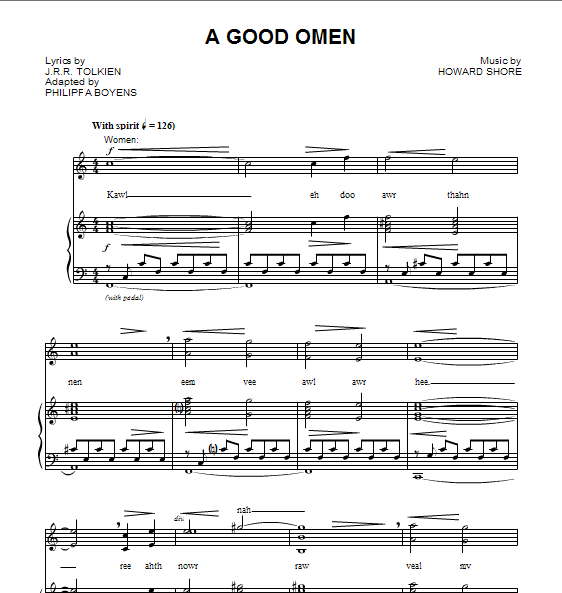 The sheet music for some of The Hobbit: An Unexpected Journey tracks has been released. We can find a few lyrics in Sindarin (translated by David Salo) in the sample pages on Music Notes: A Good Omen and Radagast the Brown. There’s also lyrics for My Dear Frodo, but as the sample has only the first page and the vocals come in much later, you cannot see the lyrics in the sample sheet music. Anyone who purchases these 3 pieces should be able to get a hold of the entire lyrics for them.
There’s also lyrics for Misty Mountains and Song of the Lonely Mountain, but they’re pretty obvious already – English texts are not our concern.
What we can find in the lyrics:
I. The Good Omen
kawleh doo awr thahn neneem vee awl awr heeree ahth nowr raw veal mv…
which corresponds with the known Sindarin lyrics from the LotR (see here):
Orthannen im vi ól
Coll e dû
Or hiriath naur
Na rovail mae sui ‚waew
Man prestant i ardhon?
Cerithar aen illiad dim úthenin?
‚In a dream I was lifted up. / Borne from the darkness / Above the rivers of fire. / On wings doft as the wind. /What’s happened to the world? / Is everything sad going to come untrue?’
II. Radagast the Brown
men aw ed ven aw gah lahd vawss
ee lye cie le em men aw leem
which corresponds with the known Sindarin lyrics (see here):
Meno, edveno
O galad vos i lais
Lim, meno lim
Na fuin, trí dhuaith …
‘Go, go forth / from [the] light soft [of] the leaves /Lightly, go lightly /to [the] nightshade, through dark-shadow’
G-i-P stands for Gwaith-i-Phethain, ‘The Fellowship of the Word-smiths’ or the linguistic website devoted to post-Tolkienian constructions in the “reconstructed” languages of Middle-earth [link].
Visit us on Facebook!
4 KomentarzyKategorie wpisu: Adaptacje tolkienowskie, Filmy: Hobbit i WP, G-i-P Report, In Westron (English), Lingwistyka
06.01.13, 02:30, dodany przez Galadhorn
Source: tolkien.hu
We present the Quenya, Khuzdûl and Black Speech dialogs from The Hobbit: An Unexpected Journey movie as they were presented on the Tolkien.hu forum. The Orkish is presented here in its Northern dialect – according to David Salo on TheOneRing.net this Neo-Orkish language borrowed words from Dwarves, Men, and even Elves of the Northern regions of Rhovanion. Together with the Sindarin dialogs (see here) these dialogs were created by David Salo, the movie language specialist. The dialogs are presented in the order of appearance.
[Thorin at Bag End :]
Shazara! ‚Silence!’ (Khuzdûl)
[Thorin at Bag End:]
Du Bekâr! Du Bekâr! ‚To arms! To arms!’ (Khuzdûl)
[Ork scout in the night:]
[…] ‚Send word to the others… we have found the Dwarf-scum’ (missing Black Speech phrase)
[Radagast’s spells (seem not to be full):]
Sí a hlare ómaquettar ‚Now hear words of my voice’ (Quenya)
Lerya laman naiquentallo ‚Free [the] animal from curse’ (Quenya)
Na coilerya en-vinyanta ‚Be its life renewed’ (Quenya)
[Yazneg, the warg-rider:]
[…] ‚The Dwarves are headed East’ (missing Black Speech phrase)
[Thorin, escaping:]
Ithrikî! ‚Steady!’ (Khuzdûl)
[Lindir in Sindarin – see here]
[Thorin in Rivendell:]
Ifridî bekâr! ‚Ready weapons!’ (Khuzdûl)
[Gandalf in Sindarin – see here]
[Elrond in Sindarin – see here]
[Yazneg on Weathertop:]
Khozdayin… Dorguz… zuranimid ‚The Dwarves… Master – we lost them’ (BS)
Shugi golgai gelnakhanishim ‚Ambushed by Elvish filth, we were…’ (BS)
[Azog to Yazneg on Weathertop:]
Sha nargiz ob-hakhtil… ‚I don’t want excuses…’ (BS)
Nargiz khobdi… Rani Khozdil! ‚I want the head of the Dwarf King!’ (BS)
[Yazneg to Azog on Weathertop:]
Murganish dum… ‚We were outnumbered…’ (BS)
Turim hag shad ‚There was nothing we could do’ (BS)
Zorzor go-kairaz obguraniz ‚I barely escaped with my life’ (BS)
[Azog on Weathertop, first to Yazneg, then to Fimbul:]
Ki go-kairag baganig. Ombar bunish! ‚Better you had paid with it’ (BS)
Khozd-shrakhun gud sha kilyash-zag ‚The Dwarf scum will not stay hidden for long’ (BS)
Giryashi taryash kirgayil ‚They will try to cross the Mountain passes’ (BS)
Zidgar obod tung nash ru khobdud. ‚Send out word… there is a price on their heads’ (BS)
[Galadriel in Sindarin – see here]
[Gandalf in Sindarin – see here]
[Galadriel in Sindarin – see here]
[Thorin in the dungeons:]
Udâmai! ‚Comrades!’ (Khuzdûl)
[Azog in the dungeons:]
[…] ‚The scent is fresh. They have taken the Mountain pass’ (missing dialog in BS)
[Azog:]
Nuzdigid? Nuzdi gast ‚Do you smell it? The scent of fear’ (BS)
Ganzilig-i unarug obod nauzdanish ‚I remember your father reeked of it’ (BS)
Torin undag Train-ob ‚Thorin son of Thrain’ (BS)
Kod ‚That one’ (BS)
Toragid biriz ‚Bring him to me’ (BS)
Worori-da ‚Kill the others!’ (BS)
Sho gad adol! ‚Drink their blood!’ (BS)
Biriz torag khobdudol! ‚Bring me his head! (BS)
16 KomentarzyKategorie wpisu: Filmy: Hobbit i WP, G-i-P Report, In Westron (English), Lingwistyka
27.12.12, 21:28, dodany przez Galadhorn
O wydarzeniu pisaliśmy już tutaj. Dziś dalsze szczegóły.
 Wydarzenie w Krakowie nosi tytuł: „Warsztaty Pisma Elfickiego, czyli tengwar dla początkujących”. Odbywają się w dniach 5-6 stycznia 2013. Zapraszamy na nie wszystkich, którzy chcą się nauczyć zapisywać polskie litery w tengwarze. Miejsce warsztatów to Szkoła Kaligrafii w Galerii 2 Światy przy ul. Brzozowej 14 w Krakowie. Mae g’ovannen!
Można zapisać się na wybrane opcje:
2 godziny – „WERSJA ABC” 11.00 -13.00 (sobota lub niedziela)
– wystarczy do nauczenia się posługiwania stalówką zamaczaną w kałamarzu oraz do poznania paru liter by móc napisać swoje imię.
4 godziny – „WERSJA ALFABET” 11.00-16.00 (sobota lub niedziela / z przerwą godzinną na obiad)
– dalsza nauka alfabetu, ćwiczenie wyrazów i zdań.
6 godzin – „WERSJA PEŁNA” (11.00-18.00 sobota lub niedziela / z przerwą godzinną na obiad)
– pełny alfabet: nauka wszystkich liter, łaczenia w wyrazy; dwie wersje zapisu tengwaru; praca końcowa – fragment poematu po elficku lub Zaklęcia Pierścienia.
A w sobotę o godz 18.00 zapraszamy na wykład Ryszarda „Galadhorna” Derdzińskiego: „Wprowadzenie w tematykę lingwistyki tolkienowskiej: języki sindarin i quenya oraz sposoby ich zapisu”
Na wykład wstęp wolny! Zapraszamy!
Cennik warsztatów:
WERSJA ABC 40,- zł
WERSJA ALFABET 70,- zł
WERSJA PEŁNA 100,- zł
Wszystkie materiały zapewniają organizatorzy! Zniżki rodzinne! Szczegóły na stronie Szkoły
5 KomentarzyKategorie wpisu: G-i-P Report, Lingwistyka, Twórczość fanów, Wydarzenia
24.12.12, 15:40, dodany przez Galadhorn
Elendilion, a Polish website about Tolkien and Tolkienists, has about 100 articles in English (Westron). See them here.
Hungarian linguist, Cerebrum (of Parf-en-Ereglas website), has a Christmas (quen. *Eruontalë) gift for us all. Below you will find his analysis concerning the Sindarin phrases from the movie The Hobbit: An Unexpected Journey.
Cerebrum, hannon le! Eglerio! Cuio anann, Mellon!
[Lindir:]
Lastannem i athrannedh i Vruinen.
Subtitle: ‚We heard you had crossed into the Valley.’
(lit.: ‚We heard that you had crossed the Loudwater.’)
lastannem: lasta- (listen) + –nn– + –e– + –m (pa.t. 1st p. pl. excl.)
i: that
athrannedh: athra- (cross) + –nn– + –e– + –dh (pa.t. 2nd p. pl. form.)
i: the
Vruinen: lenited form of Bruinen (Loudwater)
[Gandalf to Elrond:]
Mellonnen! Mo evínedh?
Subtitle: ‚My friend! Where have you been?’
(lit.: ‚My friend! Where have you gone?’)
mellonnen: mellon (friend) + –en (1st p. sg. poss.)
mo: *maw (where?), cf. A Gateway to Sindarin, p. 109
evínedh: e- + mín- (< *men- „go”) + -e- + -dh (pa.t. 2nd p. sg. form.)
Przeczytaj resztę wpisu »
42 KomentarzyKategorie wpisu: Filmy: Hobbit i WP, G-i-P Report, In Westron (English), Lingwistyka
22.12.12, 09:53, dodany przez Galadhorn
This time in Easteron (Polish), not in Westron (English) because this news concerns a linguistic event in Krakow, Poland.
Już 28 grudnia krakowskie Elfy zapraszają do kaligrafowania swoich imion, a 5 i 6 stycznia w czasie Warsztatów Kaligrafii Elfickiej spotkamy się ze sztuką pisma elfickiego i z ciekawostkami na temat języków quenya, sindarin i telerin! „Elendilion” zaprasza razem ze Szkołą Kaligrafii i Iluminacji!
 W królewskim grodzie Krakowie istnieje Szkoła Kaligrafii i Iluminacji Barbary Bodziony. Ta niezwykła instytucja współpracuje z „Galerią 2światy” na Kazimierzu. Odbywają się tam kursy, warsztaty, pokazy i wykłady z dziedziny kaligrafii, iluminatorstwa oraz dziedzin sztuki i rzemiosł, które są im pokrewne. Organizowane też są zajęcia edukacyjne dla dzieci i młodzieży. Działalność krakowskiej Szkoły Kaligrafii i Iluminacji wspiera powołana przez Annę Jeziorną Fundacja Sztuka Kaligrafii.
Już teraz w Szkole Kaligrafii i Iluminacji zamówić można wpis do egzemplarza Hobbita (lub innego dzieła Tolkiena) – dedykację w tengwarze! Można po prostu przyjść do szkoły na ulicy Brzozowej 12 w Krakowie w dniach 20-22 grudnia! Natomiast dnia 28 grudnia w kinie „Pod Baranami” w Krakowie przed seansem Hobbita. Niezwykłej podróży graficy ze szkoły będą wypisywać imiona po elficku dla wszystkich chętnych! Przyjdźcie godzinę przed seansem. Czekają też inne niespodzianki!
Zaś w Nowym Roku (w dniach 5-6 stycznia) Szkoła Kaligrafii i Iluminacji organizuje warsztaty kaligraficzne ze sztuki tolkienowskiego tengwaru! Swój wykład na temat języków i pism profesora Tolkiena zapowiedział Ryszard „Galadhorn” Derdziński. Będzie to świetna okazja żeby zebrać krakowskich miłośników Śródziemia i wspólnie poćwiczyć elficką kaligrafię!
Brak komentarzyKategorie wpisu: Fandom tolkienowski, G-i-P Report, Lingwistyka, Twórczość fanów
20.12.12, 15:25, dodany przez Galadhorn
 Miriam Simon from German forum Mellyn Lammath (see here) reports new Sindarin phrases got from The Hobbit: An Unexpected Journey:
[Lindir:] Lastannem mi athrannen di Vruinen
‚We heard ? ? in Bruinen’
[Gandalf to Elrond:] Mellon, oe(?)winedh?
‚Friend, you …?’
[Elrond:] Bara(?)nnen ‚lamhoth i ? harad. Dagannem rim na Iant Vedui.
‚? Orks ? south. We slayed [a] host by [the] Last Bridge.’
[Elrond:] Nartho i noer, toltho i viruvor! Bo iannon-‚?wan(n?)-ar?-neth-ae-vín.
‚Kindle the fires [?], bring the wine! ???’
[Galadriel:] Mithrandir, Gwenn[vin-nin-nu???]
‚Ganfalf, ?’
[Gandalf:] ?gw-i(?)sta-di-fan-eth? i chilil Lórien
‚??? Lórien’
We can help Miriam, Mellyn Lammath, Gwaith and Galadhorn to reconstruct all the dialogs from the movie. Help!
* * *
There are also big runes on the Gates of Moria and in the halls of Erebor. Have you seen them? Can you decipher them. Or maybe you have got a picture with these runes? Help us, please…
G-i-P stands for Gwaith-i-Phethain, ‘The Fellowship of the Word-smiths’ or the linguistic website devoted to post-Tolkienian constructions in the “reconstructed” languages of Middle-earth [link].
Visit us on Facebook!
7 KomentarzyKategorie wpisu: Filmy: Hobbit i WP, G-i-P Report, In Westron (English), Lingwistyka
20.12.12, 12:00, dodany przez Galadhorn
THE HOBBIT (MOVIE TRILOGY): PHRASES, LYRICS AND INSCRIPTIONS IN THE LANGUAGES OF MIDDLE-EARTH
(as translated by DAVID SALO)
C heck also our website devoted to the linguistic analysis of The Lord of the Rings movie trilogy (you will find there phrases, inscriptions and lyrics in the neo-languages of Middle-earth analyzed by the Gwaith)
I. PHRASES
Sindarin
[light green are these phrases which were not included into the movie]
Most of the Sindarin words can be found in David Salo’s A Gateway to Sindarin (see here).
I’ve got a cameo as an elf. Or another cameo. My character is called Lindir. I hang out with Elrond… I’ve got a few lines in Elvish… [Bret McKenzie, „Lindir”]
1. Elin eb i istodh na dirad lin. [source]
‘How are you?’ (lit. ‘Happy am I beyond that which you know to see you’)
*elin v. ‘I am happy!’; from elo! intj. ‘an exclamation of wonder, admiration, delight’, ‘*el-, √EL or *gelin (lenited ‘elin), *gel- ‘to be merry, happy’, √GJEL
*eb prep. ‘beyond’; cf. Quenya epë ‘before/after’?
i rel. pron. ‘who, which, that’
*istodh v. ‘you know’; ista- ‘have knowdlege’ + *-dh ‘thou’ (second-person familiar pronoun; cf. cerið (ceridh) and galoð (galodh) in PE#17, p. 132)
na prep. ‘with, by, near; to, toward, at; of’
tirad (lenited dirad) v. ‘to see’; cf. tíra- ‘see’
lin pron. ‘you’ (shouldn’t it be len instead?)
2. Boe i ‘watham. [source]
Let’s go (lit. ‘It is necessary we leave’)
boe v. impers. ‘it is necessary, one must, one is compelled to’ (specifical David Salo’s phrase used many times in the LotR movie)
i rel. pron. ‘who, which, that’; here used as ‘that’
gwatham (lenited ‘watham) v. fut. ‘we will go’; cf. gwa- ‘to go’ (PE#17, p. 148) and -m ‘we’.
3. Nauthon i miruvor ammen; man pedidh? [source]
‘Should we have a glass of wine?’ (lit. ‘I think about miruvor for us. What you say?’)
nauthon v. ‘I think’; cf. nautha- ‘conceive’
i art. ‘the’
miruvor, n. Sindarin version of the Quenya miruvórë
ammen pron. ‘to us, for us, of us’
*man pron. ‘who, what’
pedidh v. ‘you speak’; cf. ped- ‘speak’ + *-dh ‘thou’ (second-person familiar pronoun)
4. [Lindir to Gandalf:]
Lastannem i athrannedh i Vruinen. [source , source]
Subtitle: ‘We heard you had crossed into the Valley.’
(lit.: ‘We heard that you had crossed the Loudwater.’)
lastannem: lasta- (listen) + –nn– + –e– + –m (pa.t. 1st p. pl. excl.)
i: that
athrannedh: athra- (cross) + –nn– + –e– + –dh (pa.t. 2nd p. pl. form.)
i: the
Vruinen: lenited form of Bruinen (Loudwater)
5. [Gandalf to Elrond:]
Mellonnen! Mo evínedh? [source]
Subtitle: ‘My friend! Where have you been?’
(lit.: ‘My friend! Where have you gone?’)
mellonnen: mellon (friend) + –en (1st p. sg. poss.)
mo: *maw (where?), cf. A Gateway to Sindarin, p. 109
evínedh: e- + mín- (< *men- “go”) + -e- + -dh (pa.t. 2nd p. sg. form.)
6. [Elrond:]
Farannem ‘lamhoth i udul o charad. Dagannem rim na Iant Vedui. Nartho i noer, toltho i viruvor. Boe i annam vann a nethail vin. [source, source]
Subtitle: ‘We’ve been hunting a pack of Orcs that came up from the South. We slew a number near the Last Bridge. Light the fires, bring forth the wine. We must feed our guests.’
(lit.: ‘We’ve been hunting Orcs that came from the South. We slew a number at the Last Bridge. Light the fires, fetch the miruvor. We must give food to our guests.’)
farannem: fara- (hunt) + –nn– + –e– + –m (pa.t. 1st p. pl. excl.)
’lamhoth: lenited form of glamhoth (orcs, lit. “the dinhorde”)
i: who
udul: u– + tol– (tul?) (pa.t. 3rd p. sg.)
o: from
charad: stop-mutated form of harad (south)
dagannem: dag– (slay) + –nn– + –e– + –m (pa.t. 1st p. pl. excl.)
rim: great number
na: at
Iant Vedui: iant (bridge) + medui (last)
nartho: imp. form of nartha– (kindle)
i: reduced form of in (the, pl.)
noer: pl. form of naur (fire)
toltho: imp. form of toltha- (fetch)
i: the
viruvor: lenited form of miruvor
boe: it is necessary
i: that
annam: anna– (give) + –m (pr.t. 1st p. pl. excl.)
*vann: lenited form of *mann (food)
a: reduced form of an (for)
nethail: pl. form of nathal (guest)
vin: lenited form of mín (our)
7. [Lindir and Elrond:]
Lindir: Saim e-mbar a chabed athar glaind ne hi pen in miruvor. Manan in gardh na men i darthathar har?
Subtitle: ‚The kitchen is under enormous strain, we are almost out of wine. How long do you think they will be with us?’
(lit. ‚Chambers of the house ? beyond limits; for now [they are] without the wines. How ? with us they will stay ?)
Mendar uvornor [?]
Subtitle: ‚That has yet to be decided.’
To be analyzed soon…
8. [Gandalf to Galadriel:]
Nae nin gwistant infanneth, mal ú-eichia i Chíril Lorien. [source]
Subtitle: ‘Age may have changed me, but not so the Lady of Lorien.’
(lit.: ‘Alas, age has changed me, but (it) does not change the Lady of Lorien.’)
nae: alas
nin: me
*gwistant: *gwista– (change) (cf. Q vista-) + –nt (pa.t. 3rd p. sg.)
*infanneth: infant (> iphant) (aged, lit. “year-full”) + –eth (cf. prestanneth, Ivanneth)
*mal: but (cf. Q mal)
*ú-eichia: ú- (not) + *eichia- (change) (cf. Q ahya-) (pr.t. 3rd p. sg.)
i: the
Chíril Lorien: lenited form of Híril Lorien (Lady of Lorien)
9. [Galadriel to Gandalf:]
Ae boe i le eliathon, im tulithon. [source]
Subtitle: ‘If you should ever need my help, I will come.’
(lit.: ‘If it will be necessary to help you, I will come.’)
*ae: if (cf. Q ai)
boe: it is necessary
i: that
le: you (acc.)
eliathon: elia– (help) + –tho– (< –tha-) + –n (fut. 1st p. sg.)
im: I myself
tulithon: tol– (tul-?) (come) + –i– + –tho– (< –tha-) + –n (fut. 1st p. sg)
10. [Tauriel:]
Tolo hí! [analysis]
‘Come down’ (or: ‘Come here’)
tolo v. ‚come’; cf. tol-, Quenya tul-
sí (lenited hí) adv. ‚here’
11. [Tauriel:] Lyst in saim [analysis]
‘The cells are empty’
lost adj. ’empty’
in art. pl. ‚the’
sam (pl. *saim) n. ‚chamber, *cell’
12. [Angerthas Daeron runic inscription of Thorin’s sword, Orcrist:]
Nagol e-lýg Orchrist
‘Tooth of Snake, Orc-Cleaver’ [analysis]
nagol n. ‚tooth’
e en art. ‚of the’
lýg n. ‚snake’
13. [Angerthas Daeron runic inscription of Thorin’s scabbard:]
Hyrn o gorf Ithluig; ui ni madweg a suig
‘Ready for action (pl.) from impetus [of] wisdom-serpents; everlasting I [am] gluttonous and thirsty’ [analysis]
*hürn or hyrn adj. pl. ‚ready for action’ (sg. *hurn, cf. hûr n. ‚readiness for action’)
o prep. ‚from, of’
gorf gorw, n. ‚impetus, vigor’
*ithluig, n. ‚wisdom-serpents = dragons’
ui adj. ‚everlasting, eternal’
ni pron. ‚I/me’
madweg adj. ‚gluttonous’ (PE 17:144)
a conj. ‚and’
*soig adj. ‚thirsty’ (cf. Quenya soica ‘thirsty’)
Quenya
1. [Radagast:]
Cementari celvameldë, si a hlarë ómaquettar.
Lerya laman naiquentallo, na coilerya envinyanta
‘Cementari animal-friend, now listen voice-words.
Release animal from sharp pain, renew it to its life’
envinyata v. ‚to renew’; cf. Envinyatar ‚Renewer’
cuilerya n. ‚its life’; cuile-lya
Przeczytaj resztę wpisu »
5 KomentarzyKategorie wpisu: Filmy: Hobbit i WP, G-i-P Report, In Westron (English), Lingwistyka
17.12.12, 14:35, dodany przez Galadhorn
Source: Elfling (Andrew Higgins post)
Sunday Times from 18 November had a special Hobbit film magazine coverage which included several videos online. One of them by a language coach of The Hobbit film, Róisín Carty, includes an intro talk on Quenya and Sindarin and mentions that in The Hobbit films the Wizards will speak some Quenya [we have already mentioned that Radagast and probably Gandalf say Quenya spells in The Hobbit movie].
 Then she gives three examples of Sindarin [which are probably used in the Rivendell scenes in The Hobbit: An Unexpected Journey]:
Elin eb i istodh na dirad lin
‚How are you?’ (lit. ‚Happy am I beyond that which you know to see you’)
*elin v. ‘I am happy!’; from elo! intj. ‚an exclamation of wonder, admiration, delight’, ‚*el-, √EL or *gelin (lenited ‚elin), *gel- ‚to be merry, happy’, √GJEL
*eb prep. ‘beyond’; cf. Quenya epë ‚before/after’?
i rel. pron. ‚who, which, that’
*istodh v. ‘you know’; ista- ‚have knowdlege’ + *-dh ‚thou’ (second-person familiar pronoun; cf. cerið (ceridh) and galoð (galodh) in PE#17, p. 132)
na prep. ‘with, by, near; to, toward, at; of’
tirad (lenited dirad) v. ‚to see’; cf. tíra- ‚see’
lin pron. ‚you’ (shouldn’t it be len instead?)
Boe i ‚watham
Let’s go (lit. ‚It is necessary we leave’)
boe v. impers. ‚it is necessary, one must, one is compelled to’ (specifical David Salo’s phrase used many times in the LotR movie)
i rel. pron. ‚who, which, that’; here used as ‚that’
gwatham (lenited ‚watham) v. fut. ‚we will go’; cf. gwa- ‚to go’ (PE#17, p. 148) and -m ‚we’.
Nauthon i miruvor ammen; man pedidh?
‚Should we have a glass of wine?’ (lit. ‚I think about miruvor for us. What you say?’)
nauthon v. ‚I think’; cf. nautha- ‚conceive’
i art. ‚the’
miruvor, n. Sindarin version of the Quenya miruvórë
ammen pron. ‚to us, for us, of us’
*man pron. ‚who, what’
pedidh v. ‚you speak’; cf. ped- ‚speak’ + *-dh ‚thou’ (second-person familiar pronoun)
You can access the video online but you need to subscribe to The Times to do so.
G-i-P stands for Gwaith-i-Phethain, ‘The Fellowship of the Word-smiths’ or the linguistic website devoted to post-Tolkienian constructions in the “reconstructed” languages of Middle-earth [link].
Visit us on Facebook!
4 KomentarzyKategorie wpisu: Filmy: Hobbit i WP, G-i-P Report, In Westron (English), Lingwistyka
14.12.12, 19:12, dodany przez Galadhorn
Watch the fragment of this material, the moment at 5:38. We hear there something like Khuzdul Ni ikred fund which seems to mean ‚Never trust an Elf’. Do you agree? Can you help us to analyze it?
Video material
Yesterday evening we were to The Hobbit: An Unexpected Journey premiere in Galway, Ireland. The movie is splendid! And there is much more linguistic material in it than in each part of The Lord of the Ring trilogy. We could hear a lot of Sindarin (Imladris dialogs of Lindir, Elrond, Galadriel), some Quenya (Radagast’s spell in Rhosgobel), a lot of Neo Black Speech (especially when Azog was talking to his Goblins) and some Dwarvish. We need time to record, transcribe and analyze this material, but we expect you, the members of the Gwaith, would help us. So, help us, please!
G-i-P stands for Gwaith-i-Phethain, ‘The Fellowship of the Word-smiths’ or the linguistic website devoted to post-Tolkienian constructions in the “reconstructed” languages of Middle-earth [link].
Visit us on Facebook!
2 KomentarzyKategorie wpisu: Filmy: Hobbit i WP, G-i-P Report, In Westron (English), Lingwistyka
← Późniejsze wpisy · Wcześniejsze wpisy →


