17.12.12, 14:35, dodany przez Galadhorn
Source: Elfling (Andrew Higgins post)
Sunday Times from 18 November had a special Hobbit film magazine coverage which included several videos online. One of them by a language coach of The Hobbit film, Róisín Carty, includes an intro talk on Quenya and Sindarin and mentions that in The Hobbit films the Wizards will speak some Quenya [we have already mentioned that Radagast and probably Gandalf say Quenya spells in The Hobbit movie].
 Then she gives three examples of Sindarin [which are probably used in the Rivendell scenes in The Hobbit: An Unexpected Journey]:
Elin eb i istodh na dirad lin
‚How are you?’ (lit. ‚Happy am I beyond that which you know to see you’)
*elin v. ‘I am happy!’; from elo! intj. ‚an exclamation of wonder, admiration, delight’, ‚*el-, √EL or *gelin (lenited ‚elin), *gel- ‚to be merry, happy’, √GJEL
*eb prep. ‘beyond’; cf. Quenya epë ‚before/after’?
i rel. pron. ‚who, which, that’
*istodh v. ‘you know’; ista- ‚have knowdlege’ + *-dh ‚thou’ (second-person familiar pronoun; cf. cerið (ceridh) and galoð (galodh) in PE#17, p. 132)
na prep. ‘with, by, near; to, toward, at; of’
tirad (lenited dirad) v. ‚to see’; cf. tíra- ‚see’
lin pron. ‚you’ (shouldn’t it be len instead?)
Boe i ‚watham
Let’s go (lit. ‚It is necessary we leave’)
boe v. impers. ‚it is necessary, one must, one is compelled to’ (specifical David Salo’s phrase used many times in the LotR movie)
i rel. pron. ‚who, which, that’; here used as ‚that’
gwatham (lenited ‚watham) v. fut. ‚we will go’; cf. gwa- ‚to go’ (PE#17, p. 148) and -m ‚we’.
Nauthon i miruvor ammen; man pedidh?
‚Should we have a glass of wine?’ (lit. ‚I think about miruvor for us. What you say?’)
nauthon v. ‚I think’; cf. nautha- ‚conceive’
i art. ‚the’
miruvor, n. Sindarin version of the Quenya miruvórë
ammen pron. ‚to us, for us, of us’
*man pron. ‚who, what’
pedidh v. ‚you speak’; cf. ped- ‚speak’ + *-dh ‚thou’ (second-person familiar pronoun)
You can access the video online but you need to subscribe to The Times to do so.
G-i-P stands for Gwaith-i-Phethain, ‘The Fellowship of the Word-smiths’ or the linguistic website devoted to post-Tolkienian constructions in the “reconstructed” languages of Middle-earth [link].
 Visit us on Facebook!
4 KomentarzyKategorie wpisu: Filmy: Hobbit i WP, G-i-P Report, In Westron (English), Lingwistyka
14.12.12, 19:12, dodany przez Galadhorn
Watch the fragment of this material, the moment at 5:38. We hear there something like Khuzdul Ni ikred fund which seems to mean ‚Never trust an Elf’. Do you agree? Can you help us to analyze it?
Video material
Yesterday evening we were to The Hobbit: An Unexpected Journey premiere in Galway, Ireland. The movie is splendid! And there is much more linguistic material in it than in each part of The Lord of the Ring trilogy. We could hear a lot of Sindarin (Imladris dialogs of Lindir, Elrond, Galadriel), some Quenya (Radagast’s spell in Rhosgobel), a lot of Neo Black Speech (especially when Azog was talking to his Goblins) and some Dwarvish. We need time to record, transcribe and analyze this material, but we expect you, the members of the Gwaith, would help us. So, help us, please!
G-i-P stands for Gwaith-i-Phethain, ‘The Fellowship of the Word-smiths’ or the linguistic website devoted to post-Tolkienian constructions in the “reconstructed” languages of Middle-earth [link].
Visit us on Facebook!
2 KomentarzyKategorie wpisu: Filmy: Hobbit i WP, G-i-P Report, In Westron (English), Lingwistyka
11.12.12, 10:11, dodany przez Galadhorn
 We have already informed you about the existence of the lyrics in the languages of Middle-earth on The Hobbit soundtrack (see here). Now having at hand the booklet with the lyrics from the soundtrack CD we want to analyze all we can find out about the texts translated by David Salo. All the choral text is by Philippa Boyens save „The Eagles” composed by J.R.R. Tolkien and Philippa Boyens. But we can read there also that: „Choral Text Translations by David Salo” (booklet, page 6).
What is very precious in the booklet is the text by Doug Adams (the author of The Music in The Lord of the Rings Films) which analyzes the themes of the soundtrack (pages: 12, 15, 16, 18, 22). We have found these linguistic fragments in his text, and we would like to analyze it word-by-word (I used two books – David Salo, A Gateway to Sindarin and Edouard Kloczko, Dictionnaire des langues elfiques; the forms signed with * are the new words created by David Salo):
I. „Radagast the Brown” [Sindarin]
„Above this dense collection of forest murmurs, boys chorus sings a text by Phillippa Boyens” [translated by David Salo]:
Meno, edveno
O galad vos i lais
Lim, meno lim
Na fuin, trí dhuaith …
‚Away! Away! / From soft leaf-light / Hurry! Hurry! / Through dark of night … ‚. Literally the text is: ‚Go, go forth / from [the] light soft [of] the leaves /Lightly, go lightly /to [the] nightshade, through dark-shadow’.
*meno v. imp. ‘go!’; *men-, √MEN ‚way, region’
*edveno v. imp. ‘go forth’’; < *ed-men-, cf. *men-, √ET ‚forth, out’ and √MEN ‚way, region’
o prep. ‘from, of’
galad n. ‘light, bright light’
*mos (lenited vos) adj. ‘soft’; cf. Quenya mussë ‚soft’, √MUS
lais n. pl. ‘leaves’
lim adj., adv. ‘clear, sparkling, light’; cf. noro lim, Asfaloth *’run lightly, Asfaloth’ (I 222)
na prep. ‘to, toward, at’
fuin n. ‘night, gloom, darkness, dead of night, nightshade’
trî prep. ‚through’
dhuaith n. pl. ‚nightshade, dark shadow’, sg. dúath
II. „The Hidden Valley” [Sindarin]
„Gandalf eventually leads the Dwarves to the safety of Imladris, the Last Homely House and home to Elrond, Master of Rivendell. Rivendell’s timeless music is embellished with tolling chimes, harp glissandi, and female voices singing “Rivendell Revealed” in Sindarin, the Elves’ common tongue. However, Elrond is not the only Elf to hold sway in Rivendell — and Gandalf is not the only Wizard. Also present are Galadriel, the Lady of Lórien, and Saruman, wisest of his order. While the Dwarves accept the invitation issued in Rivendell’s choral text —
Edwenno brestaid en-Amar
‚Lay down your troubles, set aside your fear’ [lit. ‚Set aside troubles of [the] Earth’]
*edwenno v. imp. ‚set aside’; √ET ‚forth, out’ and √? ‚?’
*prestaid (lenited brestaid), n. ‚trouble’, sg. *prestad; cf. presta- v. ‚affect, trouble, disturb’
en, e- art. ‚of the’
Amar n. ‚Earth’
III. Galadriel’s theme [Quenya]
„Female chorus sings”:
Ninquë silë misë nár
Nóna silmë andané
‚A white fire shines within her / The light of a star, born long ago’.
ninquë adj. ‚chill, palid, white’
silë v. (aorist) ‚shines’; cf. sil- ‚shine’
misë, pron. ‚(with)in her’
nár n. ‚flame, fire’
*nóna adj. ‚born’; isolated from Apanónar ‚After-born’
silmë n. ‚starlight’
*andané adv. ‚long ago’; anda-né ‚long-was’?
And that’s all we can find in the lyrics booklet. Unfortunately we don’t receive all the lyrics in the languages of Middle-earth such as Adûnaic („An Ancient Enemy”), Black Speech („Brass Buttons”), and Sindarin („Out of the Frying-Pan”, „A Good Omen”).
G-i-P stands for Gwaith-i-Phethain, ‘The Fellowship of the Word-smiths’ or the linguistic website devoted to post-Tolkienian constructions in the “reconstructed” languages of Middle-earth [link].
Visit us on Facebook!
1 komentarzKategorie wpisu: Adaptacje tolkienowskie, Filmy: Hobbit i WP, G-i-P Report, In Westron (English), Lingwistyka
03.12.12, 09:50, dodany przez Galadhorn

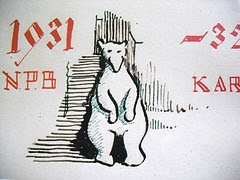
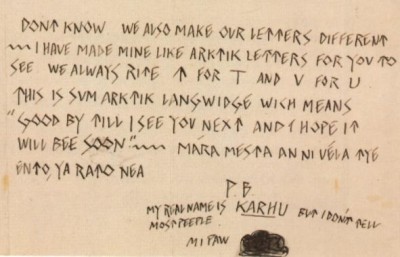
 A cóż to znowu za pomysł? Co to za język? Arktyczny? A czy wiecie, że postaci z Listów Świętego Mikołaja (ang. Father Christmas Letters) J.R.R. Tolkiena posiadają swój własny język? Czerwone Elfy, Niedźwiedź Polarny i sam „Wigilijny Ojczulek” (zwany przez nas Świętym Mikołajem na cześć miłosiernego biskupa z terenu dzisiejszej Turcji) na co dzień posługiwali się tym właśnie językiem. Profesor nazywał go arktykiem (ang. Arktik albo Arctic) czyli językiem arktycznym. W istocie była to po prostu wczesna forma języka quenya (nazywamy ją zgodnie z ówczesnym zapisem qenya). Jak sądzicie, czemu Tolkien wybrał swoją qenya, żeby przedstawić język mieszkańców Bieguna Polarnego?
Oto zdanie w tym języku (z listu z roku 1929, którego fragment reprodukujemy wyżej):
Mára mesta an ni véla tye ento, ya rato nea
‚Do widzenia aż zobaczę was znowu, co mam nadzieję będzie szybko’
I Wy możecie lepiej się przygotować na spotkanie z istotami świątecznej mitologii tolkienowskiej – wykorzystajcie czas zimowych wieczorów i zamiast marnować czas na Facebooku, uczcie się z nami języka quenya. Przypominamy Wam o kursie quenejskim, który lata temu przygotował H. K. Fauskanger z Norwegii, a przełożył na polski zespół Elendilich:
Helge Kåre Fauskanger
Kurs języka quenejskiego
Brak komentarzyKategorie wpisu: Lingwistyka, Listy Tolkiena, Pliki do ściągnięcia
30.11.12, 18:11, dodany przez Galadhorn
Calan vain Ennor!
Sí abgen edregol an i Laer ‚ovol. Lim naur ui urui di ‚Obel-i-Pheriain a menel luin. I ast vaer a thirad i Drann. Thiar bain i ndýr ah ast vaer am randirath. O Girithron na Nínui natha ovras a chared a chened.
No alwed i Laer lîn!
Przeczytaj resztę wpisu »
1 komentarzKategorie wpisu: Filmy: Hobbit i WP, G-i-P Report, In Westron (English), Lingwistyka
30.11.12, 00:01, dodany przez Galadhorn
Source: Dwarven Word of the Day gallery (The Hobbit on Facebook)


 And here they are! New Khuzdûl words (most of them are actually Neo-Khuzûl). And new examples of the Angerthas runes usage. We hope The Hobbit movie will be the opportunity to study Dwarvish language (which most complete analysis can be found on Ardalambion and on Mellonath Daeron websites) and to develop its coined, reconstructed New Dwarvish form. How do you think will we be able to speak Neo-Khuzûl one day? Will David Salo create full grammar and more complete vocabulary of the Dwarvish used in the movie?
So far we know these „Dwarven Words of the Day” (Neo-Khuzûl is marked with asterisk *):
*aznâg ‚courage’; stem ?
*aznân ‚darkness’; stem Z-N (HoMe IX 466)
*azrâd ‚magic’; stem ?
*banô ‚treasure’; stem ?
*bark ‘axe’; cf. baruk, ‚axes of’ (HoMe VII 20), Baruk Khazâd! ‚Axes of the Dwarves!’ (Appendix F); stem ?
*belgond ‘pledge’; stem ? [analysis]
*belkîn ‚fortress’; stem ?
*gund ‚cave’; cf. gundu, ‚underground hall’ (from stem gunud) (HoMe XII 352).
*urd ‚mountain’; cf. Sindarin orod; stem ?
*sigin-aimu ‘journey’; stem ?
*zul ‚beer’; stem ?
For the other Neo-Khuzûl forms from The Hobbit movie see here.
G-i-P stands for Gwaith-i-Phethain, ‘The Fellowship of the Word-smiths’ or the linguistic website devoted to post-Tolkienian constructions in the “reconstructed” languages of Middle-earth [link].
Visit us on Facebook!
Brak komentarzyKategorie wpisu: Filmy: Hobbit i WP, G-i-P Report, In Westron (English), Lingwistyka
29.11.12, 22:42, dodany przez Galadhorn
Source: MarketSaw
 Let us see the IMAX posters for The Hobbit: An Unexpected Journey midnight screenings. We have here an unexpected linguistic addition – the title of the movie written with the Tengwar letters as they are described in Appendix E of the LotR. Tolkien explained there was no official mode for using Tengwar with the English language, but on the title of the same book gave and example of an English phrase written with Tengwar. The rules there were the same as for Sindarin, with the Tehtar (representing vowels) placed above the next consecutive Tengwar letter. The creators of the IMAX posters used another mode which is similar to the mode for Quenya. The Tehtar are place above the proceeding consonantal Tengwar letter.
The inscriptions on the posters read:
the hobbit an unexpected journey
G-i-P stands for Gwaith-i-Phethain, ‘The Fellowship of the Word-smiths’ or the linguistic website devoted to post-Tolkienian constructions in the “reconstructed” languages of Middle-earth [link].
 Visit us on Facebook!
2 KomentarzyKategorie wpisu: Filmy: Hobbit i WP, G-i-P Report, In Westron (English), Lingwistyka
28.11.12, 14:20, dodany przez Galadhorn
 This illustration comes from Jude Fisher’s book The Hobbit: An Unexpected Journey. Visual Companion (chapter „The Elves”). It is a manuscript (prepared for the movies by the artist Daniel Reeve) with the Tengwar lettering, but the text is in English (Tengwar mode for English close to the one on the title page of The Lord of the Rings). Our analysis proves it’s a part of The Silmarillion (p. 193-4) [which is very similar to the paragraph in The Children of Húrin, Chapter „The Battle of Unnumbered Tears”] starting with the words
Last of all the eastern force to stand firm were the Dwarves of Belegost…
and ending with
There as the sun westered…
G-i-P stands for Gwaith-i-Phethain, ‘The Fellowship of the Word-smiths’ or the linguistic website devoted to post-Tolkienian constructions in the “reconstructed” languages of Middle-earth [link].
Visit us on Facebook!
Brak komentarzyKategorie wpisu: Filmy: Hobbit i WP, G-i-P Report, In Westron (English), Lingwistyka
19.10.12, 20:17, dodany przez Galadhorn
Source: Hollywood Reporter
 Today the Neo-Khuzdûl word of the day is aznâg ‚courage’ (the word coined by David Salo?). The information comes from The Hobbit movie profile on Facebook. The Hollywood Reporter in their „The Hard Road to ‚The Hobbit’ present new pictures from the movie set. On of them is a page of a runic book of the Dwarves (made by Daniel Reeve?). It has a nice inscription in English with Anglo-Saxon futhark runes (like these in The Hobbit book):
 They read:
Supplies of pipeweed are running desperately low. If we do not find some very soon one of our few remaining pleasures will be a thing of the past.
G-i-P stands for Gwaith-i-Phethain, ‘The Fellowship of the Word-smiths’ or the linguistic website devoted to post-Tolkienian constructions in the “reconstructed” languages of Middle-earth [link].
Visit us on Facebook!
Brak komentarzyKategorie wpisu: Filmy: Hobbit i WP, G-i-P Report, In Westron (English), Lingwistyka
19.10.12, 13:08, dodany przez Galadhorn
 It seems the runes become more and more popular thanks to The Hobbit movie promotion. Thanks to TORn we know about this advertisement in Los Angeles (see the news). We can read:
Something is afoot! Strange images have been seen all over Los Angeles. What does it mean?? It looks like breakfast – and we all know that Hobbits love breakfast so much, they eat it twice daily. But for those who have a Hobbity appetite for second breakfast, where is the best place to find it? The answer to the riddle will be revealed, in time….
We have deciphered the runes and they read (the mode for English described in the LotR III, Appendix E):
the breakfast ri.. of middle-earth await
What is the third word? Can you help?
G-i-P stands for Gwaith-i-Phethain, ‘The Fellowship of the Word-smiths’ or the linguistic website devoted to post-Tolkienian constructions in the “reconstructed” languages of Middle-earth [link].
Visit us on Facebook!
1 komentarzKategorie wpisu: Filmy: Hobbit i WP, G-i-P Report, Lingwistyka
← Późniejsze wpisy · Wcześniejsze wpisy →


 Then she gives three examples of Sindarin [which are probably used in the Rivendell scenes in The Hobbit: An Unexpected Journey]: