08.09.12, 10:46, dodany przez Galadhorn
Source: TheOneRing.net

Among the new photos from the Hobbit application that was launched yesterday (TheOneRing.net writes about it here) we have chosen one which shows more details of Dwalin’s runic tattoo. The Hobbit: An Unexpected Journey will be full of runes. About Dwalin’s runic tattoos we were writing here and here.
[Dwalin’s] tatoos are the pictorial tale about Dwarvish history, laws, customs.
We think that the signs on Dwalin’s fingers are the famous Khuzdûl battle-cry:
Baruk Khazâd! Khazâd ai-mênu!
‚Axes of the Dwarves! The Dwarves are upon you’ (RK, App F)
They are written with Angerthas Moria runes (Baruk Khazâd – right hand, Khazâd ai-mênu – left hand).
The runes in the movie occur in two types: Anglo-Saxon Futhark known in its English version from The Hobbit book and Elvish-Dwarvish Angerthas of Middle-earth known from the inscriptions and an appendix in The Lord of the Rings book. Let us check out Dwalin’s photo! Let us decipher the runes!
G-i-P stands for Gwaith-i-Phethain, ‘The Fellowship of the Word-smiths’ or the linguistic website devoted to post-Tolkienian constructions in the “reconstructed” languages of Middle-earth [link].
Visit us on Facebook!
Brak komentarzyKategorie wpisu: Filmy: Hobbit i WP, G-i-P Report, In Westron (English), Lingwistyka
02.09.12, 20:27, dodany przez Galadhorn
[News from August has been updated! Runes have been almost resolved!]
About the Sindarin/Angerthas inscription on Orkrist’s blade we’ve alredy written here. As Earl Carvalho reports, a TORn board member, Altariel Noldo, has spotted another runic inscription in Sindarin on Orkrist’s scabbard (as shown on a photo on the Weta Collectors Forum) – see the discussion on TORn board here. The photo is reproduced below.

The Cirth runes are better visible on the photo prepared by „seregon13” from the Weta Collectors forum (see here):

So we can see the inscription which reads probably as follows (obscure runes in cursive):
HÜRN O GORW ITHLUIG UI NI MADWEG A SUIG
‚ready for action (pl.) from impetus [of] wisdom-serpents; everlasting I [am] gluttonous and thirsty’
*hürn adj. pl. ready for action (sg. *hurn, cf. hûr n. readiness for action)
or hern adj. pl. wounded (sg. harn)
or hürn adj. pl. driven under compulsion, impelled (sg. horn)
o prep. from, of
gorf gorw, n. impetus, vigor
*ithluig, n. wisdom-serpents = dragons
ui adj. everlasting, eternal
ni pron. I/me
madweg adj. gluttonous (PE 17:144)
a conj. and
*suig adj. thirsty (cf. Quenya soica ‚thirsty’)
[source: David Salo, A Gateway to Sindarin]
We should remember that the sword’s handle in the movie is made of dragon’s (literally lŷg ‘snake’) tooth. It seems that the scabbard is made of the same material. It gives more sense to the scabbard’s inscription.
What do you think about our translation of the Orkrist’s scabbard runes?
G-i-P stands for Gwaith-i-Phethain, ‘The Fellowship of the Word-smiths’ or the linguistic website devoted to post-Tolkienian constructions in the “reconstructed” languages of Middle-earth [link].
8 KomentarzyKategorie wpisu: Filmy: Hobbit i WP, G-i-P Report, In Westron (English), Lingwistyka
30.08.12, 10:48, dodany przez Galadhorn
Source: Earl Carvalho
 There are more and more runes of Middle-earth (in fact Anglo-Saxon runes) in the reports from the movie set. As Earl Carvalho reports a TORn board member noticed that one of the (as yet unidentified) Dwarves in vlog 8 has some runes on his costume (see here). Click the image on the left to see the details. The runes on the Dwarf’s costume have been already decipered by the TORn board members. It seems that the WETA use Anglo-Saxon Futhark (adopted for English by J.R.R. Tolkien in his Foreword in The Hobbit book) and not the Angerthas (runes of Middle-earth) from The Lord of the Rings Appendices. The runes on the Dwarf’s costume seem to read: B R O TH E R H OO D (deciphered by Grinman – see here).

G-i-P stands for Gwaith-i-Phethain, ‘The Fellowship of the Word-smiths’ or the linguistic website devoted to post-Tolkienian constructions in the “reconstructed” languages of Middle-earth [link].
Brak komentarzyKategorie wpisu: Filmy: Hobbit i WP, G-i-P Report, In Westron (English), Lingwistyka
21.08.12, 10:42, dodany przez Galadhorn
Source: Earl Carvalho

 About another Thrór’s Key we were writing already here. This time we can analyze the runes on probable actual movie prop. As our correspondent Earl Carvalho writes the new item on the Forbidden Planet website looks like Thrór’s Key („Thorin’s Key”) for the movies finally revealed (click the photo). It seems to match the production still in this image (click the second picture).
We might be mistaken, but there seem to be two words in runes that run down the key’s blade. Who first will decipher them?
G-i-P stands for Gwaith-i-Phethdain, ‘The Fellowship of the Word-smiths’ or the linguistic website devoted to post-Tolkienian constructions in the “reconstructed” languages of Middle-earth [link].
3 KomentarzyKategorie wpisu: Filmy: Hobbit i WP, G-i-P Report, In Westron (English), Lingwistyka
01.08.12, 08:59, dodany przez Galadhorn
 Here’s an image of a hip-flask that was given to the folks who worked in The Hobbit‚s costume department. The picture was provided by our special G-i-P Spy. We think it may be a good example of the runes/language that will be used in the films.
So far we have estimated that the runes are Angerthas Moria (or Angerthas Erebor) and the last line is the year date:
***
********
2012
Help us to decipher the rest of the runic inscription!
[Update:]
Pekka, a Tolkienian linguist from Poland proposes:
I’m not quite sure how you got the year, but from what I can see the runes seem to be Anglo-Saxon (and Hobbitish at the same time).
The first line makes no sense to me: H C(=K) D.
The second one, however, goes beautifully: SURVIVOR (where U=V).
Maybe H.C.D. (or H.K.D.) mean: Hobbit Costume Department? If so we have here:
[Anglo-Saxon runes:]
H[obbit] C[ostume] D[epartment]
SURVIVOR
[Angerthas Erebor runic numerals, know from The Book of Mazarbul:]
2012
G-i-P stands for Gwaith-i-Phethain, ‘The Fellowship of the Word-smiths’ or the linguistic website devoted to post-Tolkienian constructions in the “reconstructed” languages of Middle-earth [link].
3 KomentarzyKategorie wpisu: Filmy: Hobbit i WP, G-i-P Report, In Westron (English), Lingwistyka
13.07.12, 17:07, dodany przez Galadhorn
Source: TheOneRing.net
 Thanks to Earl Carvalho, our friend from TORn, we know that it’s a movie replica, not the actual design of the movie prop! Folks from Badali Jewelry gave a sneak peek at one of the first items in their newly licensed The Hobbit line of jewelry: Thror’s Key!
Engraved on the barrel of the key is the same phrase written in Anglo-Saxon (and not Dwarvish Angerthas Moria) runes that are found on Thrór’s map in J.R.R. Tolkien’s The Hobbit book:
FIVE FEET HIGH THE DOOR
On the reverse side of the barrel there is probably the rest of the inscription:
AND THREE MAY WALK ABREAST
We wonder if Anglo-Saxon runes from The Hobbit book and the Middle-earth Dwarvish runes, Angerthas Moria, from The Lord of the Rings Appendices will coexist in Peter Jackson’s movie.
G-i-P stands for Gwaith-i-Phethdain, ‘The Fellowship of the Word-smiths’ or the linguistic website devoted to post-Tolkienian constructions in the “reconstructed” languages of Middle-earth [link].
1 komentarzKategorie wpisu: Filmy: Hobbit i WP, G-i-P Report, In Westron (English), Lingwistyka
13.07.12, 00:10, dodany przez Galadhorn
Earl Carvalho from TheOneRing.net team reports that at Day 1 of ComicCon, the TORn staff down in San Diego caught some close-ups of weapon replicas from The Hobbit movie.
This close-ups are very interesting for our research. The first picture (click the photo below) shows the runic inscriptions on two Dwalin’s axes. In Angerthas Moria this inscriptions are as follows:
UMRAZ
UKhLAT
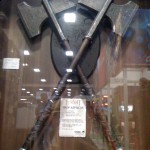 As our Special Spy reports (attention! it’s an exclusive G-i-P information!) these inscriptions are in (David Salo’s) Neo-Khuzdûl and probably mean: Grasper and Keeper (it’s a linguistic and literary pun because two Sisters Brontë’s dogs had the same names). Additional information about Dwalin’s tatoos which comes from the Spy is as follows: the tatoos are the pictorial tale about Dwarvish history, laws, customs. One of them is the famous Khuzdûl battle-cry: Baruk Khazâd! Khazâd ai-mênu! written with Angerthas Moria runes. The Spy told us also about Bifur’s special feature. Because of his special disability (?) he will speak only in Khuzdûl.
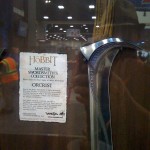 Another photo from ComicCon shows the details of the Orkrist blade. We can see there Elvish runes (Angerthas Daeron) and the Sindarin inscription which is as follows:
NAGOL E-LŶG ORKhRIST
‚Tooth of-Dragon Orc-Cleaver’
The sword’s handle is made of dragon’s (literally lŷg ‚snake’) tooth. Our Special Spy told us that Thranduil’s sword will have a lot of runic inscriptions too. We hope to find out what they are soon.
In The Hobbit movie we will find probably another language constructed specially for the films. It will be Wargs’ tongue. The chief of the Wargs, giant white wolf will comunicate with his Wargs in a simple gluttal language.
G-i-P stands for Gwaith-i-Phethdain, ‘The Fellowship of the Word-smiths’ or the linguistic website devoted to post-Tolkienian constructions in the “reconstructed” languages of Middle-earth [link].
11 KomentarzyKategorie wpisu: Filmy: Hobbit i WP, G-i-P Report, In Westron (English), Lingwistyka
28.03.12, 08:38, dodany przez Galadhorn
 Earl Carvalho, our friend from TheOneRing.net reports that the latest Warner Bros. movie newsletter has a Dwarvish „Word of the Month”. It’s Neo-Khuzdûl belgond ‚pledge’ (Polish ‚zastaw; gwarancja; zobowiązanie’). It’s probably a neologism adapted by David Salo that will be used somewhere in the films… something like the Dwarves’ pledge to regain their treasure and their Kingdom from Smaug.
 Earl writes also about Dwalin’s tattoos: on his head, Dwalin has some tattoos that seem to resemble the Dwarven art, maybe even a kind of the runes. In addition to the tattoos on his head (which are quite easy to spot), there seem to be inscriptions on his axe as well. On the left there is an image from one of the production vlogs where you can see the axe runes.
The first one seems to be Angerthas rune <u>. The second may be <ch> (see Appendix E in The Return of the King). Maybe you can help us to decipher the rest of them and to find the meaning of Dwalin’s tatoo?
It’s the belgond of the Fellowship of the Word-smiths to find as many linguistic details in the upcoming movies as possible. Help us to write new reports and to decipher our puzzles.
G-i-P stands for Gwaith-i-Phethdain, ‘The Fellowship of the Word-smiths’ or the linguistic website devoted to post-Tolkienian constructions in the “reconstructed” languages of Middle-earth [link].
4 KomentarzyKategorie wpisu: G-i-P Report, In Westron (English), Lingwistyka
20.03.12, 14:01, dodany przez Galadhorn
Śource: „The Hobbit: Deciphering Dwarf Documents” (Heirs of Durin website)
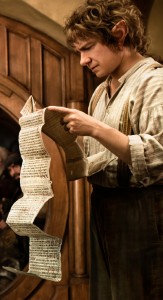
 A Tolkien scholar, DarkJackal, having discovered the highest resolution images from The Hobbit movie of Bilbo holding the contract which Thorin & Co. wrote, has done good job trying to decipher it. His findings are based on some visible evidence, and a whole lot of guesswork. Let us see what can be seen on this picture (read the whole text from Heirs of Durin website).
In the movie the text of Bilbo’s contract is much more developed than in the book: maybe even ten times longer – see (1) below. DarkJackal has divided the contract into sections roughly based on paragraphs, labeled A through L, which are upside-down in the image. His attempt to sharpen the writing in Photoshop actually helped very little. His reconstruction is a mere guess in many places (read about his method in the linked text). The result (very interesting!) can be found there too. DarkJackal will be very thankful if somebody could help him to decipher whole document. Let us help him!
(1) In his book J.R.R. Tolkien provided us with this text of Thorin’s text:
“Thorin and Company to Burglar Bilbo greeting!
For your hospitality our sincerest thanks, and for your offer of professional assistance our grateful acceptance. Terms: cash on delivery, up to and not exceeding one fourteenth of total profits (if any); all traveling expenses guaranteed in any event; funeral expenses to be defrayed by us or our representatives, if occasion arises and the matter is not otherwise arranged for.
Thinking it unnecessary to disturb your esteemed repose, we have proceeded in advance to make requisite preparations, and shall await your respected person at the Green Dragon Inn, Bywater, at 11 a.m. sharp. Trusting that you will be punctual,
We have the honour to remain
Yours deeply
Thorin & Co.”
(Source: J.R.R. Tolkien The Hobbit)
Brak komentarzyKategorie wpisu: Filmy: Hobbit i WP, G-i-P Report, In Westron (English)
10.01.12, 19:44, dodany przez Galadhorn
Today we are honored to present a G-i-P Report provided by Marc Zender (see his course on Tolkienian linguistics – at Harvard University).
 The 4th Production Video Blog of The Hobbit contains a short scene of what appears to be Gandalf etching his mark on Bilbo’s door. (See 05:00 in the video posted here). The image shows a bent nail at the base of Gandalf’s staff (see part of his cloak to the right), etching a rune into Bilbo’s green door. The rune is certh 19 G which, in addition to being the first sign in Gandalf’s name, is also used as his mark throughout The Lord of the Rings — e.g., labeling the firecrackers he brings for Bilbo’s birthday party, as a signature in his urgent letter to Frodo, as his secret mark on Weathertop, etc.
Readers of The Hobbit will remember that Gandalf marks Bilbo’s door in order to lead the Dwarves to Bag End: „… with the spike of his staff [he] scratched a queer sign on the hobbit’s beautiful green front-door.” The next day, when he arrives with the Dwarves, he beats „a hard rat-tat on the hobbit’s beautiful green door … with a stick” which „knock[s] out the secret mark that he had put there the morning before”. Bilbo is of course unaware of any of this, and therefore expresses some surprise and irritation at the Dwarves’ presumptuous arrival and assumptions, remarking: „I have no signs on my door—it was painted a week ago—, and I am quite sure you have come to the wrong house”. Gloin responds: remarking „I assure you there is a mark on this door—the usual one in the trade … ‘Burglar wants a good job, plenty of Excitement and reasonable Reward,’ that’s how it is usually read.”
Of course, Tolkien never provided his readers with an image of this complex mark. Rather than invent it, the filmmakers seem to have opted instead for the reasonable replacement of Gandalf’s initial.
Marc Zender
[I would like to add to this information that in fact we do know the actual sign Tolkien wanted to appear on Bilbo’s door. In J.R.R. Tolkien: Artist & Illustrator by Scull & Hammond, p. 99, we can find Tolkien’s sketch with the door of Bag End, with Gandalf and three mysterious signs. They seem to be Anglo-Saxon runes (used in The Hobbit for the Dwarvish script): B for Burglar, D for Danger and a sign of a jewel/diamond for Reward. See the actual inscription in our news from 2009 – here).
Richard „Galadhorn” Derdzinski.]
Brak komentarzyKategorie wpisu: Filmy: Hobbit i WP, G-i-P Report, In Westron (English), Lingwistyka
← Późniejsze wpisy · Wcześniejsze wpisy →


